Search This Blog

Showing posts with label Sokey Bear. Show all posts

Thursday, May 26, 2011

As we go into this Memorial Day holiday weekend lets us NEVER forget the sacrifices of our brothers, sisters, mothers, fathers, friends and all family who have given their life protecting ours.
In a small way of saying thanks please use or distribute the coloring sheet below.

Also please know that on June 4th Virginia will honor its fallen firefighters from the previous year. Below is info taken from a brochure that will be given to all firefighters’ attending the wildland fire academy next week.  I hope you enjoy the poem that I wrote using a poem a Canadian Firefighter wrote to honor the victims’ of 9/11 several years ago as a guide.


The annual Virginia Fallen Firefighters Memorial Service will be held on Saturday, June 4, 2011 at the Richmond Inter­national Raceway Complex’s Old Dominion Building.
If you cannot be there physically you can honor those who gave their life in the line of duty with a moment of silence.

Seven firefighters who died in the line of duty or have been rec­ognized by the Virginia Line of Duty Act in the last year will be honored for their bravery and dedicated public service.


The fallen firefighters to be honored are Assistant Chief Carl Persing of Dale City Volunteer Fire Department and City of Manassas, Firefighter Timothy Pigg of Amherst Vol­unteer Fire Department, Chief Posey Dillon of Rocky Mount Volunteer Fire Department, Firefighter William “Danny” Altice of Rocky Mount Volunteer Fire Department, Fire­fighter William Harold “Hal” Clark of Atlantic Volunteer Fire and Rescue Company, William Obenchain Jr. of Roanoke Fire-EMS, and Zygimantas Zalys of City of Manassas. In addition to honoring recently fallen firefighters, the memo­rial service will honor the memory of all Virginia firefighters who have given their lives in the service of the Common­wealth of Virginia.


"The Fallen!"
In the battle against the beastly fire...
Standing together, ready to fight!
To help the victims of every incident,
committed to service, by day and by night.

These are the courageous Firefighters,
In their cities and towns of Virginia land.
They stand together as really true friends,
Routinely they're all working hand in hand.

Everyone of them looks after the other,
They know no borders...!
Ready to help in their unselfish way,
Without fear, they follow their orders!
Seven of them gave their lives in Virginia,
 two thousand and ten...!
Firefighters everywhere will remember them,
And their feelings of loss will never be gone.


By the way, live streaming the service this year will be on the web.  There is a link at the bottom of our home page, www.vafire.com that will be active the day of the service. 

Tuesday, May 10, 2011

Wildfires Continue to burn in several states / Historic Weather

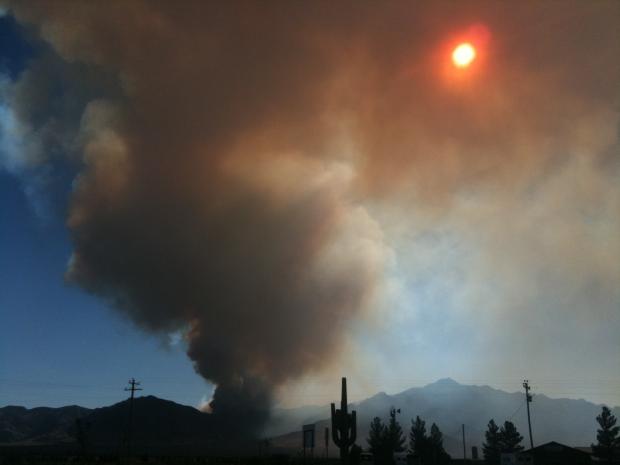
As wildfires burn on and hundeds if not thousands of firefighters respond not all their safey issues are fire related.
Blaze at North Carolina wildlife refuge burns 20,000 acres

Dry thunderstorms spark more fires in West Texas


Okefenokee fire nears 72,000 acres as it burns toward Florida


Wildfires prompt evacuations in 2 New Mexico communities


Historic month for wild weather in US


May 10, 2011 - 4:27PM  AP
US government meteorologists say April was a historic month for wild weather in the US, and it was not just the killer tornado outbreak that set records.
April included an odd mix of downpours, droughts and wildfires.
Six states - Illinois, Indiana, Ohio, Kentucky, Pennsylvania and West Virginia - set records for the wettest April since 1895.
The US also had the most hectares burnt by wildfire for April since 2000.
Add to a record 305 tornadoes from April 25-28, which killed at least 309 people and the most tornadoes ever for all of April: 1875.
US scientists also looked for the fingerprints of global warming and La Nina on last month's deadly tornadoes, but could find no evidence to blame those often-cited weather phenomena.
Meanwhile, Texas and parts of several surrounding states are suffering through a drought nearly as punishing as some of the world's driest deserts, with much of the nation focused on a spring marked by historic floods and deadly tornadoes.
Some parts of Texas have not had any significant precipitation since August.
Bayous, cattle ponds and farm fields are drying up, and residents are living under constant threat of wildfires, which have already burnt across thousands of square kilometres.
Grass is so dry it crunches underfoot in many places and some ranchers are culling their herds to avoid paying supplemental feed costs.

Wednesday, April 27, 2011

These are not normal days


"These are not normal days, this is not a spring that comes around often, we haven't seen conditions like these since 1917," Mary-Kay Hicks, Texas Forest Service, said.

ODESSA, Texas — At least two homes have burned and a West Texas community near Odessa has been evacuated after new wildfires erupted in parts of the windswept, tinder-dry region.
Two fires prompted the evacuation of the 800-resident community of Pleasant Farms, about 12 miles south of Odessa. Reporters on the scene say two homes in the subdivision already have burned. No injuries have been reported.


Having a Plan:
One of the problems fire officials had in North Texas is that people in the fire's path refused to their homes.
Authorities say Central Texans need to be on alert for the threat of wildfire and need to have a plan just in case.
"We're in a good position because we have time to plan out, and figure out where you want to meet, where will you go, what will you take with you," Hicks said.

IF ASKED TO EVACUATE
Local Public Safety officials may deem evacuation is necessary due to wildfires in your area. If asked to evacuate, please do so in a speedy and responsible manner.  Authorities do not ask you to leave if it is NOT in your best interest. They know how difficult a decision this is and how emotional it can be. PLEASE cooperate and NOW is the TIME TO PREPARE. The more you are READY, when the call comes to GO you are SET and you can get out of harms way.

I offer you these tips for those who evacuate.

Planning for Evacuation
·                       Ask your local Emergency Management Office about community evacuation plans.
·                       Learn proposed evacuation routes and locations of public shelters.
·                       If you do not have personal transportation, make arrangements with friends or your local government.
·                       Make a plan with family members for a destination if you have to leave your community.  In your planning, consider different scales of evacuation – neighborhood, town, county, etc.
·                       Assemble a Disaster Supply Kit.
·                       Keep your car fueled if evacuation seems likely.  Gas stations may be closed during an emergency, or unable to pump gas during power outages.
·                       Know how to shut off your home’s electricity, gas and water supplies at main switches and valves.

What to do if asked/told to evacuate
·                       Gather all persons in the house together.
·                       Household members outside the area may be advised not to return during an evacuation.  They may be directed to a reception center or mass care shelter where you can join them.
·                       Do not call your local fire or police departments for information.  Emergency workers will need their lines for emergency use. 
·                       Stay tuned to your Emergency Alert System radio station or local AM radio station. I say AM because they usually have a more continuous news reporting of an emergency.
·                       Turn off lights and unnecessary appliances.
·                       Close and lock windows and doors.
·                       Check with neighbors to see if they need assistance.  Offer to share transportation.
·                       Let others know where you are going.
·                       If you need a ride, try to get one with neighbors or contact your local Emergency Management Office.
·                       If you have livestock, shelter them.  Leave them at least a three-day supply of stored feed and water that has been protected from possible contamination.

How to travel
·                       Keep the car radio tuned to an Emergency Alert System station.
·                       Be aware of designated evacuation routes.
·                       Avoid routes that are anywhere near the fire, you DON’T need to get a closer look.

What to take with you
Essential items.  You may be away from home for a few hours to a few days.
·                       Clothing for several days.
·                       Toilet articles (Soap, toothbrush, toothpaste, shampoo, etc.)
·                       Prescription medicines, medical equipment and important medical records.
·                       Special dietary foods.
·                       Baby supplies.
·                       Blankets, pillows, and towels (if you plan on staying at a Public Mass Care Shelter).
·                       Identification and important papers.
·                       Checkbook, credit card and cash.
·                       Your cell phone AND charger. Now might be a good time to get that compact charging battery, many are no bigger than a pack of cigarettes and cost less than $20 and can charge your cell a couple of times..

About your pets
·                       Only seeing-eye dogs and other service animals will be allowed inside most reception centers and mass care shelters.
·                       In many communities, shelters have plans to accommodate pets, check out the restrictions BEFORE you need to know..
·                       Make plans ahead of time to take your pet to stay at relatives, friends or a kennel outside the affected area.
·                       Know pet-friendly hotels and motels.
·                       Prepare an emergency kit for your pets; include collars & leashes, a three-day supply of food, bowls, litter boxes, photographs, and a week’s supply of medications that your pet may be taking.
·                       Make sure your pets wear collars with current license and rabies tags, and identification tags that include information on where you will be staying during the emergency.
·                       Use a pet carrier for each of your pets to make transportation easier.


THANK for
Listening