It now seems that the heat wave affecting Virginia has broken and with that some rain is beginning to occur in places which are a welcomed sight for firefighters, farmers and all of Virginians. However with the rains there have been a few scattered storm related problems. Power outages continue to be a major issue.
Power Outages as of 1900 9 July:
Isolated severe thunderstorms during the afternoon and evening of 8 July and 9 July caused additional power outages across Virginia
Statewide 9,014 (-4,031 since Sit Rep #15)
Dominion 3,629 (-2,916)
· Southeastern Virginia 1,877
· Northern Virginia 750
· Shenandoah Valley/Western Piedmont 592
· With respect to 8 July storms, power restoration projected to be completed on 10 July
APCO 5,385 (-1,115)
· Amherst
Since there is no real new news about wildfire activity
in Virginia I thought I would talk about water. No not the
water that is currently falling from the sky but about the
water that is delivered on a wildfire from a variety of aircraft.
I hope you find this info interesting and informative.
Aerial Firefighting Tutorial
Introduction
The use of aircraft to drop fire retardant, foam, or water to suppress wildfires is an essential wildland firefighting tool. The speed, mobility and retardant delivery capability of aerial firefighting aircraft make them very effective resources in support of firefighters on the ground. The variety of aircraft available within U. S. aviation assets provides an appropriate firefighting capability for nearly every wildland fire situation, from wilderness to the urban interface.
The use of aircraft to drop fire retardant, foam, or water to suppress wildfires is an essential wildland firefighting tool. The speed, mobility and retardant delivery capability of aerial firefighting aircraft make them very effective resources in support of firefighters on the ground. The variety of aircraft available within U. S. aviation assets provides an appropriate firefighting capability for nearly every wildland fire situation, from wilderness to the urban interface.
Aircraft
There are three primary kinds of aerial firefighting aircraft available within the U. S.
There are three primary kinds of aerial firefighting aircraft available within the U. S.
- Multi-Engine Airtankers:


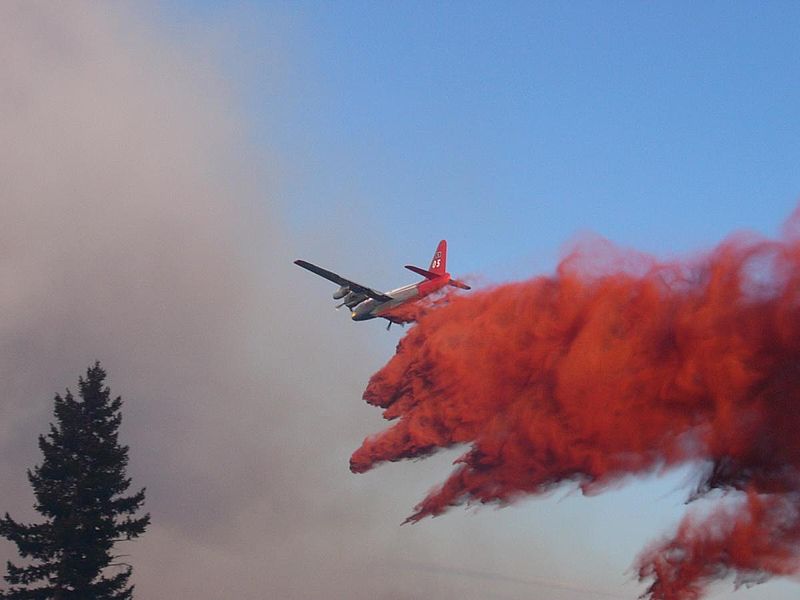


Multi-engine airtankers are comprised of ex-military and retired commercial transport aircraft. They carry from 1800-3,600 gallons of retardant. The speed, range, and retardant delivery capability of these large capacity airtankers make them very effective in both initial attack and large fire support. These airtankers typically make retardant drops from a height of 150 to 200 feet above vegetation and terrain, at airspeeds from 125 to 150 knots. Large fixed-wing airtankers have complex, computer controlled retardant dispersal systems capable of both precise incremental drops and long trailing drops one-fourth of a mile or more in length. Retardant flow rates can also be controlled to vary the retardant coverage level dispersed as required by the intensity of the fire behavior and vegetative fuel type.
- Helicopters:


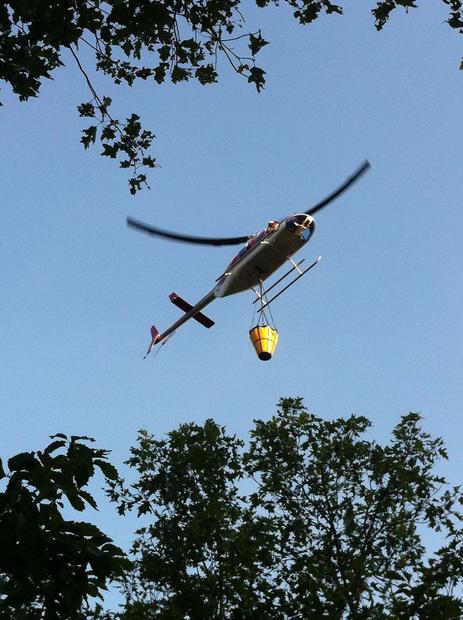


Small, medium and large helicopters carry from 100 to 3,000 gallons of water, foam, or retardant in either buckets slung beneath the aircraft, or in fixed-tanks. Large helitankers can be very cost effective, making rapid multiple drops of 2,000 gallons or more on escaping wildfires by refilling at nearby water sources or at portable retardant bases. The internally mounted retardant tanks for the larger helicopters are also computer controlled, which allow them to drop precise incremental patterns or long trailing lines as required by the fire situation. This is particularly important in urban/ wildland fire interface situations near water sources where they can bring to bear rapid revisit times and precise retardant dropping accuracy. Small and medium helicopters are most effective in the direct support of firefighters on the ground, making precision drops on specific targets.
- Single Engine Airtankers (SEATS):

These small, fixed-wing aircraft carry from 400-800 gallons of foam or fire retardant. SEATS can operate from remote airstrips and open fields or closed roads, reloading at portable retardant bases. SEATS are predominantly modified agricultural aircraft; however, the 800-gallon Air Tractor 802 is designed specifically for wildland firefighting. SEATS are most effective in the initial attack of small wildfires within 50 miles of a reload base where turn-around times are short and repeated drops can be made quickly.
And now for some Water Trivia

- although three percent of the Earth’s water is fresh, only one percent is available for human consumption. In fact, if all the world’s water were fit into a gallon jug, the fresh water available for human use would equal only about one tablespoon.
- 80 percent of the Earth’s surface is water—it acts as an insulator and helps regulate global temperature.
- water is the only substance found on Earth naturally in three forms—water can be solid, liquid, or gas.
- the average person uses well over 133 gallons of water per day.
- Structural firefighters estimate to protect a Single-family dwelling takes about 5,000 gallons of water.
Trivia Challenge
1. How long can a human survive without water?
a. one day
b. one week
c. one month
d. two months
a. one day
b. one week
c. one month
d. two months
2. How much does one gallon of water weigh?
a. 3.52 pounds
b. 15.62 pounds
c. 8.34 pounds
d. 11.25 pounds
a. 3.52 pounds
b. 15.62 pounds
c. 8.34 pounds
d. 11.25 pounds
3. On average, how much water is used to hand wash a sink full of dishes?
a. 10 gallons
b. 20 gallons
c. 30 gallons
d. 50 gallons
a. 10 gallons
b. 20 gallons
c. 30 gallons
d. 50 gallons
4. Approximately how many gallons of water does it take to make four new tires?
a. 2,000
b. 1,000
c. 1,600
d. 150
a. 2,000
b. 1,000
c. 1,600
d. 150
5. Approximately how many gallons of water does it take to manufacture a new car?
a. 3,000
b. 9,000
c. 20,000
d. 39,000
a. 3,000
b. 9,000
c. 20,000
d. 39,000
6. In the United States, from what material were the first water pipes made?
a. metal
b. rubber
c. fire-charred logs
d. clay
a. metal
b. rubber
c. fire-charred logs
d. clay
Trivia Challenge - Answers
1. b
2. c
3. c
4. b
5. a
6. c
2. c
3. c
4. b
5. a
6. c
HOW MUCH WATER We talked about various aircraft delivering between 100 and 3,000 gallons of water/retardant but just how much is 1,000 gallons? can you visualize?
Here are a few ways to help...
One acre foot equals 326,700 gallons of water. Picture a football field (approximately one acre) covered one- foot deep in water.


